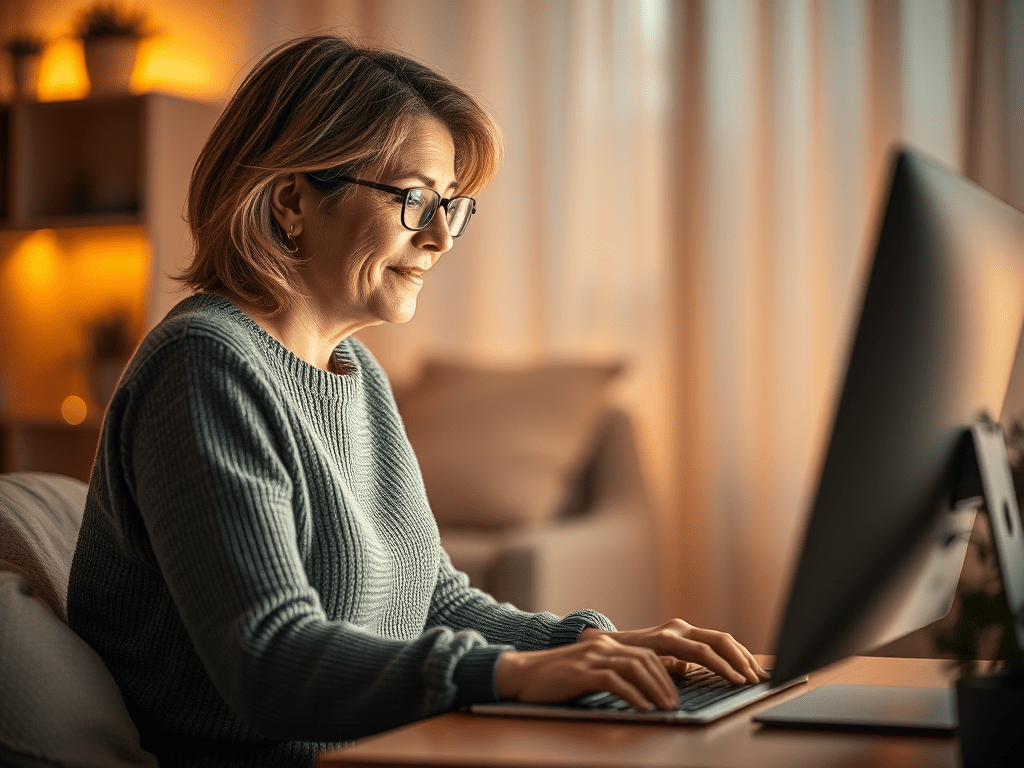
Offering flexibility with human connection
Over the past number of years, online counselling has become an established and effective way of working therapeutically. For many of my clients, it offers a level of flexibility and accessibility that simply isn’t possible with face-to-face sessions alone but still still allows for depth, safety, and meaningful connection.
If I’m completely honest, when I first encounters this form of therapy as an option, I was a little sceptical. As a non technical person, who rarely has a need for a computer, and as someone accustomed to face to face sessions it took a global pandemic to show me an alternative! The necessity to continue seeing my clients rapidly introduced me to new ways of working.
In my practice, I now offer a blended approach: working primarily online, while continuing to provide in-person appointments one day a week in Dublin city centre. This allows clients to choose the format that best supports them at different points in their journey.
Starting face-to-face, continuing online
For some people, meeting in person at the beginning of therapy feels important. An initial face-to-face session can help establish trust, rapport, and a sense of safety, particularly for clients who are new to counselling or returning after a long break.
Once that relationship is established, many clients find that continuing online feels both natural and effective. The therapeutic connection remains, while the practical barriers of travel, time, and scheduling are reduced. This blended model can offer the reassurance of an in-person start, combined with the flexibility of online work.
Greater availability and earlier access to support
One of the most significant benefits of online counselling is availability. Without the constraints of physical room bookings or commuting time, it is often possible to offer appointments sooner.
For clients who are feeling overwhelmed, distressed, or simply ready to begin therapy, shorter waiting times can make a meaningful difference. Accessing support sooner rather than weeks later can help prevent difficulties from becoming more entrenched.
Therapy from a familiar, comfortable space
Many clients find that attending sessions from their own home or a private, familiar space helps them feel more relaxed and open. For some, this can make it easier to speak about difficult experiences or emotions.
Online counselling also supports continuity. Sessions can continue during periods of travel, illness, caring responsibilities, or changing work patterns, which helps to reduce the disruption that sometimes leads clients to pause therapy altogether.
A flexible approach, tailored to the client
Importantly, online counselling is not about replacing face-to-face work, but about offering choice. Some clients prefer to work entirely online; others value the option of occasional in-person sessions. Needs can also change over time.
By combining online counselling with a limited number of in-person appointments, it is possible to offer a responsive, client-led approach that balances accessibility with personal connection.
If you’re considering counselling and wondering whether online sessions might suit you, I’m happy to talk this through and explore what feels right for you. And, if you’re unsure whether online counselling is the right fit, an initial face-to-face session can provide a gentle starting point.
 Patricia Farrell MIACP Counselling and Supervision
Leave a comment